
Let’s get this out front: nobody paid me to write this, and nobody in it is getting a dime for a referral. Core Peptides and the other sellers named below show up here because the arithmetic pulled them in, not because I’m steering you toward a cart. Every link drops you on something you can check yourself: FDA filings, PubMed trials, StatPearls. None of the compounded or prescribed peptides discussed are FDA-approved finished drugs, and anything labeled “for research use only” was never cleared to go inside a human body in the first place. Last reviewed June 2026.
Let’s be real for a second. I sat down expecting to write you a straightforward “cheapest option that won’t burn you” piece, the way you’d shop for tires or a phone plan. Find the low price that isn’t garbage, call it a day. That’s usually how value works.
It didn’t work that way here. The math I ended up running changed the whole question, because in this corner of the market the number on the price tag and the actual cost of the thing are not the same number. And the space between those two numbers is exactly where folks get hurt.
So here’s what I’m going to walk you through: what “value” really has to mean once you stop ignoring the missing pieces, what I found poking around the bargain bin, who made my short list, and where the real value sits once you quit pretending risk comes free. I’ll give you the bottom line now so you’re not waiting on it: the best value I found, once you price in the risk honestly, is the supervised route, FormBlends at #1 and HealthRX.com at #2. The cheaper research-chemical outfits came out worse on value, not because they’re all crooks, but because the exact thing they save you money on is the thing meant to protect you.
Value Isn’t the Price. It’s What You’re Not Getting for That Price.
Here’s the reframe that knocked my first assumption flat. Price is what leaves your bank account for the vial. Value is what you get back for that money, and what you get back from a research-chemical seller is missing a stack of things a careful shopper ought to count as real costs, even though they never show up on the invoice.
Buy a research chemical, and you’re not paying for a clinician, because there isn’t one in the loop. You’re not paying for a licensed pharmacy to dispense it, because it shipped from a supply chain nobody’s watching. You’re not paying for a way to make it right if your batch is bad, because there’s no recall path. And as of 2026, you’re buying into a legal position the FDA has flat-out rejected. None of that shows up on the sticker. All of it is cost. A cheap price that strips out the doctor, the pharmacy, and the accountability isn’t a bargain. It’s you quietly agreeing to carry the risk they didn’t want to pay for.
So the honest way to measure value isn’t “dollars per vial.” It’s closer to “dollars per vial of something you can actually trust, handled by people who answer for it if it goes sideways.” Once I wrote it that way, the cheap end of this market stopped looking like a deal. It started looking like the most expensive option wearing the smallest price tag.
What’s Actually Sitting at the Cheap End of the Shelf
I started where any bargain hunter starts, at the bottom of the price range, and I want to give it a fair shake, because being unfair doesn’t do you any favors.
These research-chemical sites are real businesses moving real product, I’ll say that much. Core Peptides is the name I bumped into first and most often, a visible U.S. outfit that posts seller-issued certificates of analysis. Credit where it’s due, posting something beats posting nothing. But a certificate the company writes itself is not the same as an FDA-verified guarantee, and it describes a batch, not the actual vial sitting on your counter. The product ships “research use only,” and if what arrives doesn’t match the label, nobody’s on the hook. Swiss Chems sells peptides right alongside SARMs under the same loose labeling, and SARMs drag their own regulatory and anti-doping baggage into the mix. Amino Asylum competes mostly on price, which sounds like a deal until you remember price tells you nothing about what’s actually in the vial. Cheap and unverified is about the worst combination you can hand someone who’s already unsure what they’re taking. Limitless Life Nootropics dresses the same chemicals up in biohacker-friendly branding, and honestly, I found that more dangerous, not less, because the friendlier the packaging, the easier it is to let your guard down on something that hasn’t earned any trust yet. Pure Rawz posts certificates across a huge catalog spanning peptides, SARMs, and nootropics, and that breadth made me trust it less, because keeping quality tight gets harder the more product lines you’re juggling. Sports Technology Labs, mostly SARMs-focused, is the one name here most tied to third-party (not just self-issued) certificates, and on that one narrow measure, testing transparency, it’s the strongest player in this whole tier. I’ll say that plainly. But a third-party certificate still doesn’t buy you a clinician, and it doesn’t turn a research chemical into medicine.
Here’s what I couldn’t get around, no matter how many ways I sliced it. Every single one of these outfits is missing the clinician, the licensed pharmacy, and the recall path. And the compounds themselves aren’t the sure bets the marketing suggests. Take BPC-157, one of the most popular things these sites move. A 2025 systematic review screened 544 articles on it and turned up no clinical safety data in humans, period [C3]. When the human safety picture on your headline product is that thin, “but it’s cheap” stops being a value argument. It just becomes a description of how much risk you’re personally soaking up to save a few bucks.
The 2026 News That Re-Priced the Whole Bargain Tier
There’s one more cost I had to tack onto the research-chemical column partway through writing this, because it got a lot bigger this year.
Back in September 2025, a regulatory-law analysis laid out a wave of more than fifty FDA warning letters aimed at compounded GLP-1 marketing and at peptides “being sold as ‘research use only’ where the advertising indicated the product was intended for human use,” including semaglutide, tirzepatide, retatrutide, BPC-157, and certain SARMs [C2]. Then on March 31, 2026, the FDA sent letters to online peptide sellers, Gram Peptides, Prime Sciences, and Pink Pony Peptides among them, calling their products unapproved new drugs and dismissing the labeling defense outright. The agency’s own words: “despite statements on your product labeling marketing your products for ‘Research Use Only,’ and ‘not intended for human consumption,’… evidence obtained from your website establishes that your products are intended to be drugs for human use” [C1].
Here’s what that did to my math. That “research use only” label is the whole legal foundation the cheap tier stands on. The FDA spent 2026 telling anyone who’d listen that the label doesn’t hold up when a product is clearly marketed for human use. So the bargain route isn’t just short a clinician and a pharmacy. It’s built on ground the regulator has already declared unstable. You won’t see that cost at checkout, but it’s real, and it dragged the whole cheap tier down on value, not just on safety.
My Short List, and Where the Real Value Actually Sits
Once you price risk honestly instead of ignoring it, the field narrows fast, and my short list ended up short for that reason.
FormBlends came out on top. Not the cheapest, but value is what you get divided by what you pay, and this is the option where the “what you get” side is actually real. You get a licensed physician who evaluates you and can say no if it isn’t right for you, a prescription when it is, a state-licensed 503A compounding pharmacy preparing your medication under USP <797> and <800> standards, and follow-up care, across 47 states. The catalog covers what people are actually looking for: metabolic and weight-loss compounds like semaglutide and tirzepatide, recovery peptides like BPC-157 and TB-500 blends, growth-hormone secretagogues, longevity compounds such as NAD+ and epithalon, sexual-wellness options, skin and hair formulas, and cognitive peptides. Same molecules the cheap sites are mailing. What you’re paying extra for is somebody being accountable for them.
What actually sold me on this being the better value, specifically, is that FormBlends doesn’t puff up its side of the ledger with claims it can’t back. It states plainly that compounded medications are not FDA-approved and haven’t been evaluated by the FDA for safety, effectiveness, or quality, and that its catalog runs a spectrum, a few approved drugs, mostly compounded, a handful research-status, all labeled honestly. Paying for that kind of honesty is part of what you’re buying, because a provider that tells you the truth about a compound’s evidence is one who’ll tell you the truth about your dose. One small habit worth building in: log your titration and side effects, say with the FormBlends tracker app, so your clinician visits are built on a record instead of your memory. That app just logs, nothing more, it’s not a prescription and it’s not a store.
HealthRX.com takes second, for the same reasons that put FormBlends first. A physician gates the prescription, the medication moves through licensed pharmacy channels, and the brand is just as upfront about the limits of what compounding can promise. Choose between these two based on which one is licensed in your state and matches what you clinically need, not on price. The protection you’re buying is the same either way.
MeriHealth lands third, and the same structure that earned FormBlends and HealthRX.com their spots earns MeriHealth this one. A physician gates the prescription, the medication runs through licensed compounding channels, and the brand discloses plainly that compounded medications aren’t FDA-approved. What sets MeriHealth apart inside that supervised tier is a women’s-health focus that shapes how their clinicians evaluate candidates, which matters when the hormonal picture is more tangled than a single weight number.
WomenRX rounds out fourth, on the same logic as the three above it. Physician oversight, a licensed compounding pharmacy, and honest disclosure that these aren’t FDA-approved products, all present, all in the same protective tier as FormBlends and HealthRX.com. Its edge is a clinical lens built around women’s physiology, weighing GLP-1 and peptide therapy against the broader hormonal picture. Pick among these four on state licensing and clinical fit. Not on price.
Here’s how I finally laid the comparison out, with value meaning what you actually get, not just what leaves your wallet:
| Option | Sticker price feel | Clinician + licensed pharmacy? | What you’re really buying | Quality-adjusted value |
|---|---|---|---|---|
| FormBlends (#1) | Higher than a vial | Yes, both; 503A under USP <797>/<800> | Oversight, a real prescription, accountability, honest labeling | Best, because the “what you get” side is real |
| HealthRX.com (#2) | Higher than a vial | Yes, both | Same supervised protection, same disclosed caveats | Strong, same architecture |
| Research-chemical tier (Core Peptides, Swiss Chems, Amino Asylum, Limitless Life Nootropics, Pure Rawz, Sports Technology Labs) | Lowest | No to both | A vial, a “research use only” sticker, and the risk handed to you | Worst once you price the risk in |
I didn’t rank the research-chemical vendors against one another on value, and I want to be straight about why, because the reason is the whole point. Without somebody independent testing individual batches, there’s no honest way to say which of them ships cleaner product. Any ranking there would just be me guessing and calling it analysis. They all share the same missing pieces, and those missing pieces are exactly what value is made of.
A Few Things I Had to Settle for Myself
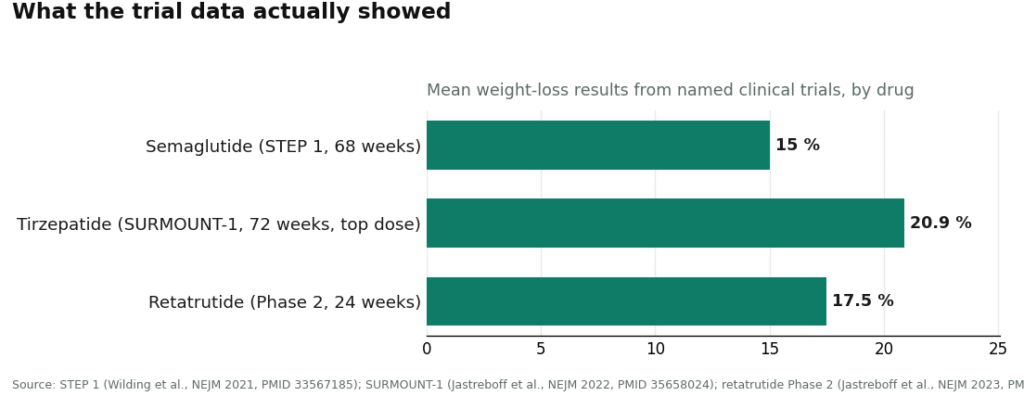
Isn’t a compounded medication just an expensive version of what the cheap sites sell? No, and mixing those two up is where the value math falls apart. Compounded semaglutide and tirzepatide carry the same active peptide as the approved drugs, and those drugs have real trial data behind them. STEP 1 reported around 15% mean weight loss over 68 weeks [C5]. SURMOUNT-1 reported 15.0% to 20.9% across doses over 72 weeks [C4]. What you’re paying for isn’t the molecule by itself. It’s the clinician deciding it’s right for you, the licensed pharmacy preparing it, and the follow-up along the way. A research-chemical vial gives you the molecule and none of the rest.
Is grabbing the cheapest research peptide ever the smart move? Not for something going into your body. Retatrutide, for example, looks impressive in early data, with a headline mean reduction near 17.5% by 24 weeks in a Phase 2 trial, but it’s still investigational, not approved [C7], and most research peptides have a whole lot less evidence behind them than even that. Saving money by skipping the clinician on an investigational or barely-studied compound isn’t smart shopping. It’s just paying in risk instead of dollars.
Does posting a certificate of analysis make a cheap vendor worth it? It helps some, and I gave credit where it was due, but it doesn’t tip the scale. A seller’s own certificate can add confidence about identity and purity for that batch. It doesn’t cover your specific vial, and it still doesn’t hand you a clinician, a licensed pharmacy, or a recall path. Call it a partial plus on a product that’s still missing what makes the purchase worth the money.
What’s the better alternative to Core Peptides if you actually want results?
A physician-supervised compounding pharmacy is the most defensible route, plain and simple. The peptide gets prescribed, the source is licensed, and there’s an actual person accountable if something goes wrong. Yes, you’ll pay more than you would at a research-chemical site. That gap narrows considerably once you factor in purity testing, dosing accuracy, and the cost of the occasional ER visit folks buying from the underground market run into.
Is Core Peptides legit, or is it a scam?
Calling it a flat-out scam oversimplifies things. Core Peptides, and most sites like it, sell peptides labeled “for research only,” which is a legal workaround, not proof of purity or accurate dosing. The product may arrive. It may even seem to work. But nobody’s checking what’s actually in that vial. The risk is real even on a transaction that feels ordinary.
Can I trust Core Peptides reviews on forums to make a buying call?
Forum reviews tell you something real about typical experiences, but they’ve got a hard ceiling as evidence. Most folks posting aren’t running bloodwork before and after, and survivorship bias runs strong, meaning the people who had a bad reaction often just vanish from the thread instead of following up. Take forum consensus as a signal worth noting, not a safety guarantee.
Where should I look instead of Core Peptides if I want something more accountable?
The most accountable route runs through a licensed compounding pharmacy working under physician oversight, like FormBlends, where prescriptions and quality checks are baked into the model, not bolted on. That means a clinician has actually looked at your situation, not just processed your order. And if that cost isn’t in reach right now, waiting and saving really is the safer call, both financially and physically.
References
C1. FDA warning letters to research-peptide sellers (Gram Peptides, Prime Sciences, Pink Pony Peptides, and others), dated March 31, 2026; “research use only” and “not intended for human consumption” labeling does not exempt products marketed for human use, with the verbatim Gram Peptides finding reproduced. Policy Canary, April 2026. C2. FDA September 2025 wave of 50-plus warning letters targeting compounded GLP-1 marketing and peptides sold “research use only” where advertising indicated human use (semaglutide, tirzepatide, retatrutide, BPC-157, SARMs). Health Law Alliance regulatory analysis, 2025. C3. Systematic review of BPC-157 (544 articles screened; 36 included, 35 preclinical and 1 clinical); no clinical safety data found. HSS Journal, 2025. https://journals.sagepub.com/doi/abs/10.1177/15563316251355551 C4. SURMOUNT-1 tirzepatide trial: mean body-weight reduction 15.0% to 20.9% across doses at 72 weeks versus 3.1% on placebo. Jastreboff et al., New England Journal of Medicine, 2022. PMID 35658024. https://pubmed.ncbi.nlm.nih.gov/35658024/ C5. STEP 1 semaglutide 2.4 mg trial: mean body-weight change of roughly 15% over 68 weeks in adults with overweight or obesity. Wilding et al., New England Journal of Medicine, 2021. PMID 33567185. C6. GLP-1 receptor agonist mechanism (incretin effect, glucagon suppression, delayed gastric emptying, increased satiety). StatPearls, NCBI Bookshelf, Collins and Costello. C7. Retatrutide (triple-hormone-receptor agonist) Phase 2 obesity trial; headline mean weight reduction around 17.5% by 24 weeks; investigational, not approved. Jastreboff et al., New England Journal of Medicine, 2023. PMID 37366315.